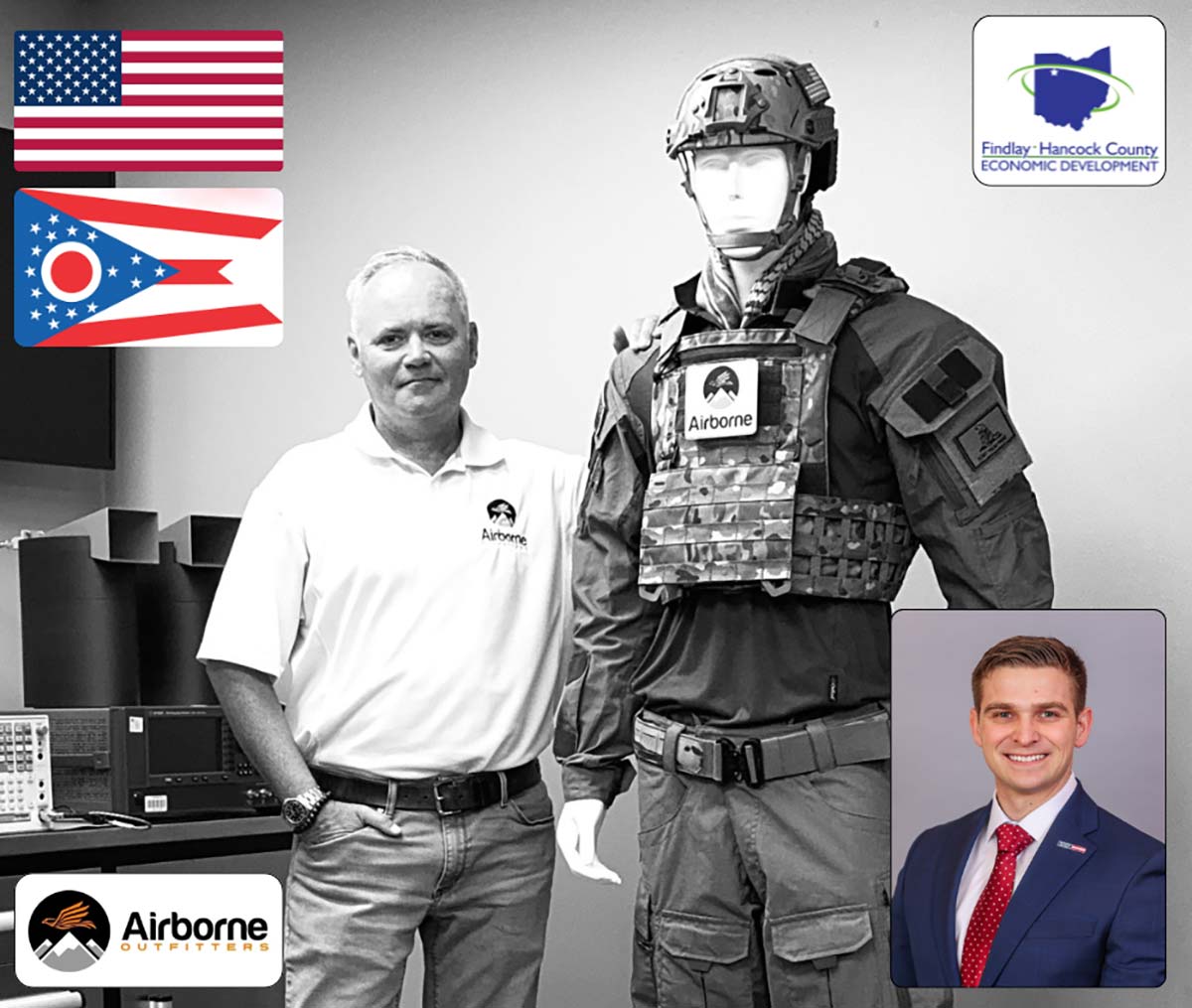
A Plan to Place Findlay-Hancock County at the Center of Rapid Growth in Advanced Defense Tech
By Sarah Mayle
In today’s volatile world, the U.S. is in a race to develop and manufacture the best tech, especially in the critical area of defense. With drone manufacturer Anduril currently building a $900 million facility to produce autonomous systems in Columbus, the time is right to attract more defense partners to Ohio – and specifically, Hancock County.

Jason B. Evatt, retired U.S. Air Force Intelligence Officer who founded Findlay defense tech company Airborne Outfitters. Evatt served for more than 26 years.
Evatt and Ohio Rep. Ty Mathews – who served as a U.S. Army Infantry Officer and as a battle captain in Iraq – are pooling their unique expertise into a concept they call the Findlay Defense Incubator. They hope to make Ohio – and specifically Findlay – a regional hub for defense industry growth through state incentives, partnerships with area universities to develop curriculum, and the construction of an extremely high-tech, highly classified facility for defense tech research.
The landscape of war has changed drastically as technology advances, and the wars in Ukraine and Israel have exposed a dire need to further develop counter-drone defense. China is a near-peer to the U.S. in technology and preparedness for tomorrow’s war and is posturing to take over Taiwan – the microchip center of the world – by 2027. The technological battlefield – who controls the electromagnetic spectrum, as in satellites, GPS, and radar – is of critical importance. And artificial intelligence and autonomous vehicles are already gathering reconnaissance and hastening decision making. The race is on to develop elite, advanced and innovative defense tech quickly, and to do it well.
“I always say the next decade or two will be won by who controls space and who controls AI militarily,” Evatt said. “…AI isn’t just a tool, it’s a force multiplier for decision speed, coordination and survivability. In milliseconds, algorithms can interpret radar returns, prioritize threats, and execute responses that once took human operators minutes to hours.”
Field of Dreams: The SCIF
Founded in 2016, Airborne Outfitters is a Service-Disabled Veteran Owned Small Business (SDVOSB), headquartered in Findlay. The company develops and manufactures products and services for the U.S. Government and partner nations, focusing on problem-solving and innovation. Their mission is, “providing today’s warfighter with the gear and equipment to win tomorrow’s war.” Evatt said he initially started Airborne Outfitters because he wanted to address shortcomings he observed in taking care of missing soldiers.
“When you’ve been in intelligence for 26 years, you start to notice vulnerabilities,” he said. “These vulnerabilities are going to be very important in the next fight.”
Airborne Outfitters specializes in electromagnetic spectrum, counter-UAS (Unmanned Aerial Systems), and radar cross-section (RCS) modification research and technologies. Through a research and development grant and contract with Naval Surface Warfare Center, Crane Division (NSWC Crane) in Indiana, the company is home to a rare anechoic chamber. This ultra-expensive specialized chamber, about the size of a semi-trailer, is an echo-free room engineered to completely absorb reflections of sound and electromagnetic waves. It is the ideal environment to test antennae characterization and radar cross-section parameters.


Building upon Airborne Outfitters’ location in Findlay, Evatt said the first step to attract defense industry development is building a SCIF – Sensitive Compartmentalized Information Facility. SCIFs are highly secure environments typically found on government bases and used by the U.S. military, national security, and intelligence communities. They operate within comprehensive, multi-layered security systems to protect top secret and classified work.
A SCIF is extremely expensive to build – about $1,200 per square foot – and requires a government sponsor.
NSWC Crane is a shore command of the U.S. Navy. It is, Evatt said, the electromagnetic warfare capital of the world with engineers and scientists devoted to its research. Airborne Outfitters received a Letter of Endorsement from NSWC Crane for a possible SCIF in Findlay, which would allow for the classified development, processing and prototyping of the kind of tech that will be needed to fight a war unlike any before. With their sponsorship, Airborne Outfitters would be able to do classified work on the U.S. Government’s behalf, and they would like to open the SCIF to other companies as well.
“Because a SCIF is so expensive and mostly unobtainable for the average company, we would love to find a way to build one here,” Evatt said. “The idea is to use it as a service – if a small company wants to do classified work, we would lease the space for that purpose. The second piece is, we could hopefully establish something with Crane, for their engineers and scientists to work out of the facility on a rotational basis for a year or two at a time.”
“Other companies are not going to relocate in Findlay just because we’re here. If you say they can co-locate with a naval entity, that’s a different story. So, what we’re trying to do is kind of like a ‘Field of Dreams, if you build it, they will come,’ but you’ve got to have a reason to come.”
Having a SCIF available for lease would invite more small and mid-sized defense companies to the table and drive innovation. And SCIF space, Mathews said, is in high demand.
Ohio Incentives: Enriching the Playing Field
Mathews (R-Findlay) spoke in October at the 24th Annual Information Assurance Forum held at The University of Findlay, which focused this year on Autonomous Mobility. There, he explained the efforts he and other lawmakers have made to increase Ohio’s appeal to defense companies, and how he has worked with Evatt. Evatt also spoke at the event.
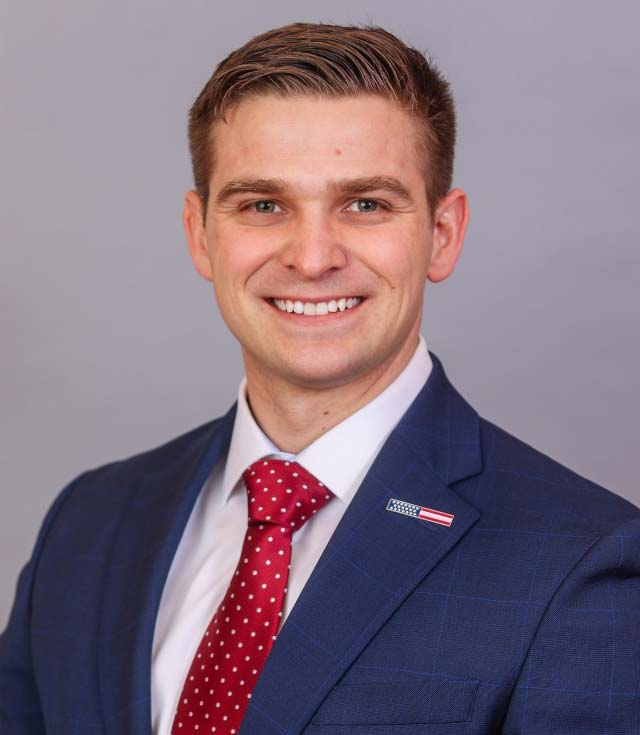
State Rep. Ty Mathews (R-Findlay) has introduced legislation to encourage defense tech companies to relocate and grow in Ohio. He sees Findlay as the ideal location.
“That’s where I just really fell in love with it,” he said. “I started thinking of coming back to the states and to Ohio and running for office, and I thought, ‘How do we attract those emerging tech companies that are developing this technology to our state?’ I have a hypothesis right now that when we talk about emerging technology, it’s basically synonymous with defense. Defense tech and defense companies are really driving this innovation right now.”
Like Evatt, Mathews believes Anduril’s investment will serve as a catalyst to drive growth in Ohio. The climate is also right, Mathews said, because of U.S. President Donald J. Trump’s movement toward awarding contracts to smaller defense companies as opposed to the five formerly established large defense manufacturers.
Mathews’ plan to attract defense companies to Ohio includes:
- House Bill 292, introduced by Mathews, proposes the creation of the Ohio Defense Commission. The commission would be made up of 13 members, including legislators and regional representatives, to guide defense-related strategy and investment and make choices on where to spend the Ohio Defense Fund. The Ohio Defense Fund would provide state matching dollars for defense and emerging tech-related companies and projects.
- Through House Bill 332, Mathews proposed the Defense Link Deposit Program, a system to lend money to eligible small defense-oriented businesses at a rate below the present borrowing rate. The bill aims to help businesses lower borrowing costs and invest in growth without directly using taxpayer dollars in the state’s general revenue fund.
- Through House Bill 291, Mathews introduced the creation of the Ohio International Trade Commission with the goal to advance a cooperative between Ohio and Japan, Ireland, Israel and two other countries to be designated by the Director of Development. The goal of the commission would be to encourage multilateral trade and investment; joint research agreements; business and academic exchanges; the creation of technology centers; and mutual support of infrastructure investment.
Mathews and Evatt hope that through these initiatives, matching dollars for a SCIF could possibly be obtained. Airborne Outfitters and Evatt’s vision, Mathews explained, “are a great example of what we want to enable in our state – and we think – Northwest Ohio.”
“…So, if you’re a company looking to build SCIF space, you’ll now have a matching pot of money,” Mathews said at the event. “If you’re a company looking to pull down emerging technologies, or a tech transfer program, there will be money out there for you. Or, if you’re just a company looking to expand and now you need matching dollars, this defense fund will be there to link you with that.”

Chris Keller, executive director, Findlay-Hancock County Economic Development
“Our office supports the Findlay Defense Incubator and their initiatives,” Keller said. “A diverse economy is a strong economy. When we can offer everything from skilled trade jobs to careers in science and technology, we give people reasons to stay, grow, and invest right here. That mix keeps our region competitive for the long term.”
The Importance of Education
When it comes to defense, “the 800-pound gorilla in every room of the Department of War,” Evatt said, is counter-UAS: How do you defend against drones? That’s why Evatt is working with the University of Findlay, Tiffin University, and Bowling Green State University to develop counter-drone curriculum that would provide training, certificates and degrees to advance and support this critical field – and hopefully, the growing local defense technology workforce.
“We need counter-drone training on so many levels,” Evatt said.
As part of that education and the overall vision, Evatt would like to build a counter-UAS test range and MSO (Military Service Obligation) training facility with a live demonstration capability.
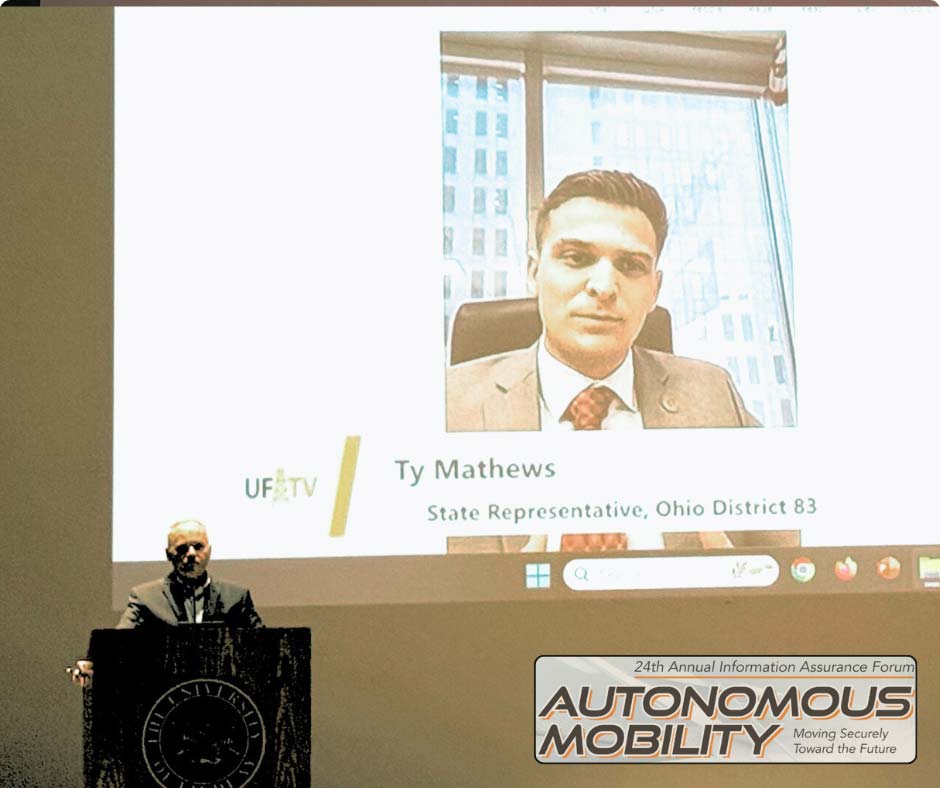
Mathews and Evatt pictured at the 24th Annual Information Assurance Forum on Autonomous Mobility, held at the University of Findlay. Both spoke about the Findlay Defense Incubator and the worldwide race to develop defense technology.
Mathews is working to make it happen.
“As a state representative, I’m trying to position Ohio to be the leader in defense technology and emerging technology because at the end of the day, how I envision this is, it’s AI. It’s electronic warfare. It’s autonomous vehicles. It’s quantum computing. It’s whatever you think emerging tech is, it can be found in the defense industry. And it seems like every type of company is moving in this direction.
“I’d like to bring it to Northwest Ohio.”