In every regard, Tony Iriti’s quest was for excellence, and his impact reaches every corner of Findlay. His legacy is the Findlay we know today – and what we can dare to become tomorrow.
Tony Iriti didn’t want Findlay to just be good. He wanted it to be great. A man who possessed a remarkable talent for bringing people together, Iriti spent more than 30 years in leadership roles teaching and inspiring people to collaborate for something bigger.
“…Albert Einstein defined insanity as “repeating the same process over and over and expecting to get different results,” then-Mayor Iriti wrote in a letter introducing The Greater Findlay Community Plan, released in 2006. “…Good is the enemy of great. We don’t have great schools because we have good schools. We don’t have great government because we have good government. We don’t have a great community because we have a very good community. In order to move from “good to great” we must change the processes that made us good to processes that will make us great.”

Anothony “Tony” Iriti
Truly a Father of Findlay, Findlay-Hancock County Economic Development remembers Anthony “Tony” Iriti, who passed away on May 6, 2026 at the age of 76. Whether he was Mayor, a Findlay City Councilman, County Auditor, CEO of the Northwest Ohio Flood Mitigation Partnership, Executive Director of Findlay-Hancock County Economic Development, a coach, mentor or friend, in everything he did, Tony Iriti brought people together. He was the ultimate coach in sports and in life; a visionary who inspired those around him, kept everyone laughing, and never shied away from a “grand challenge” to lead the community on a path to greatness – always together.
The Cube and Flag City Sports Complex
Originally from Etna, Pa. (just across the Allegheny River from Pittsburgh), Tony moved to Findlay in 1978. His first job in Findlay was as a computer systems analyst, organizing information into a data center for the Hancock County auditor to manage tax programs. Iriti next worked for Hewlett-Packard, and during that time ran for Findlay City Council. He was elected and served from 1984-1987. Then in 1987, Tony was elected as Hancock County Auditor and over 16 years introduced a number of technological advancements, moving on from the role in 2004 when he was elected mayor.
Tony’s familiarity with the minute details – the inner workings of the community – prepared him to deftly lead Findlay with a great vision. And there was a lot he wanted to do.
While work began to collaborate with more than 500 people through committee meetings, focus groups and public forums for the Greater Findlay Community Plan, another of Iriti’s earliest agenda items was The Cube. Lu Draper – who was events coordinator for the Findlay-Hancock County Chamber of Commerce; started the Convention and Visitors Bureau; and was Parks and Recreation Director during Tony’s mayorship – said Iriti envisioned state-of-the-art baseball and softball facilities, ones that would be multi-functional and for all ages and abilities at The Cube.

Lu Draper, friend and former coworker of Iriti, holds a copy of The Greater Findlay Community Plan.
Through public-private partnerships, the Marathon Diamonds were completed in the spring of 2006, and the Flag City Sports Complex was born, featuring state-of-the-art fields, electronic scoreboards, batting cages, and concessions. Marathon Petroleum Corp. was the title sponsor, and the five fields are: Fifth Third Field; Craig & Mary Lou Anderson Field; National Lime & Stone Field; Rettig Enterprises Field; and the Anthony P. Iriti Field.
“We sold the five fields and the naming rights, but one was sponsored by more than one company,” Draper said. “We sat with some of the main contributors and they wanted to name it after Tony because he was the one who had the vision for it.”
Draper remembers standing with Tony behind a team’s dugout at the first tournament held at the Marathon Diamonds just before a game was to start. Teams had come from across Ohio, Indiana, Michigan, and Illinois to play.
“Some things stick with you for life,” she said. “We were under the lights, and the coach had his team all sitting on the bench and he told the kids, ‘Look around, look down. I guarantee you’ll never get better than this,’ and he continued to inspire them for the game. Nobody in our area had ever seen a facility like this.”
The Flag City Sports Complex adds to the quality of life in Findlay – a goal of the Community Plan – and has had a tremendous economic impact. In addition to the University of Findlay using it for baseball and softball, numerous high school, regional and district tournaments are held there each year. The U.S. Women’s National Softball Team played at the fields in 2014 and 2015, drawing thousands of spectators. And in 2025, the Flag City Sluggers – representing Findlay in the Great Lakes Summer Collegiate League – played their inaugural season. The Sluggers compete regionally and are supported by Major League Baseball.
Miracle Park, also part of the Flag City Sports Complex, came after Tony’s time as mayor, but the idea for it was part of the Greater Findlay Community Plan. The facility includes Miracle Field – where those with special needs can play baseball in a stadium all their own – and Miracle Playground, a safe and fun environment for play.
Iriti also wanted The Cube to serve as a community emergency shelter for natural disasters, and renovations were completed in the fall of 2006.
“He wanted to make The Cube more multi-use, a refuge for emergencies,” Draper said. “The renovations had just happened and then right away in 2007 we needed it. I remember he called me at 11:30 the night of the flood and said, ‘Lu, you need to get to The Cube, we’re going to open it as a shelter.’”
He sent someone to make sure she got there safely.
The Historic Flood of 2007
Over the course of two back-to-back rain events, extreme rain – about 10 inches – fell on the Blanchard River watershed in August of 2007, causing a historic, 1-in-100-years flood. The river rose almost 7.5 feet above flood stage and was a sliver from equaling Findlay’s worst flood on record in 1913. It caused about $100 million in damage and about 900 people had to be evacuated. The city and state declared a state of emergency, and Hancock County was declared a federal disaster area.
“I spent the next four days and nights at The Cube,” Draper said. “We served about 150 families and the facilities worked fantastic. We had showers, restrooms, a washer and dryer, concessions, movie screens, The Heritage nursing home brought us tons of blankets and pillows they had sent over from Tiffin, and the community brought us donations like you would not believe. The (American) Red Cross and (Federal Emergency Management Agency) were able to set up at The Cube.”
Findlay native Cliff Hite, a former Ohio Representative who served the region during the flood, said he and Tony did all they could to guide Findlay toward recovery. Iriti convinced then Gov. Ted Strickland to come experience the damage firsthand.

Cliff Hite, former Ohio Representative and Senator, and former head football coach for Findlay High School.
As a result of Tony’s leadership, Findlay received crucial local, state and federal assistance. Kathy Launder, chief assistant to the mayor, said prior to the 2007 flood, Iriti had put in place a call center to handle non-emergency calls regarding flooding, manned by city employees and open after regular office hours. It was activated for the first time during the flood of 2007 and was a great help as a central communication point.
Was Tony the right person at the right time to handle the flood?
“I believe that 100 percent,” Draper said. “Tony was my friend, but I don’t say it because of that. Some of his best attributes were that he was always thinking ahead and was so community minded. He always anticipated what the next step was, and in everything he did he started with the end result in mind.”
Ohio Director of Development Lydia Mihalik was mayor of Findlay from 2012-2018 and, during the 2007 flood worked closely with Iriti to obtain grant assistance through her role with Hancock County Regional Planning Commission. Mihalik said a transcendent leadership skill Tony possessed was discernment. In the case of the flood, he deferred to the experts trained to handle emergencies at the right times – but he was never afraid to ask tough questions, make difficult decisions and change processes for the better. She learned that from him.

Former Findlay Mayor Lydia Mihalik.
Mihalik noted that, when the August 2007 flood happened, Tony had been defeated in the May primary that year for re-election – his term was over at the end of 2007. But the private sector had great faith in his ability to lead and chose him for his next venture, the Northwest Ohio Flood Mitigation Partnership.
“When people lose elections, they often ride off into the sunset and don’t come back,” Mihalik said. “It took a lot of courage and pride in the community for him to step into his roles leading flood mitigation and then as economic development director. He is a big reason they were so successful. At the end of the day, if it weren’t for Tony Iriti, Findlay wouldn’t have enjoyed the growth and success we enjoy to this day.”
Flood Mitigation – a Shift from Recovery to Prevention
The quest to “fix flooding” would remain a mission of Iriti’s the rest of his time in Findlay. He may have lost his second bid for mayor, but instead in 2008, became CEO of the Northwest Ohio Flood Mitigation Partnership. He got to work solving Findlay greatest challenge, shifting the discussion from recovery to prevention.
Iriti laid the groundwork for change by advocating on the local, state, and national levels for funding; bringing together business, community, and civic leaders; working with the U.S. Army Corp of Engineers; creating a conservancy district; bringing together communities within the Blanchard River Watershed; and educating stakeholders about the problem.
During his tenure, the Flood Partnership was awarded $3 million in state funding to begin acquiring and removing flood prone property along the Blanchard River in Findlay and Ottawa, and to prepare for future flood control improvements. And in 2009, Tony was part of a team who helped champion a 0.25 percent sales tax increase to fund flood mitigation efforts. The tax lasted for 10 years and raised more than $32 million crucial to flood mitigation projects.
Iriti also visited Columbus, Ind. with former President and CEO of Findlay Publishing Company Dave Glass to meet and collaborate with leaders in a community similar to Findlay, facing similar challenges. FPC’s Blanchard River Broadcasting runs four of its seven radio stations from Columbus, and Glass always found the two communities to be remarkably similar – the population, the distribution of white-collar and blue-collar jobs, the mix of union and non-union workers, the economic complexion in general. Findlay experienced a devastating flood in 2007, and in 2008, it was Columbus, Ind.’s turn. The connections made were the beginning of an extremely valuable partnership.
Findlay-Hancock County Economic Development
In 2010, the Findlay chamber of commerce, visitor’s bureau and economic development offices were restructured and came together under the umbrella of the Findlay-Hancock County Alliance. Leaders chose Iriti to be director of economic development, and he began the role in 2011.

John Haywood, president and CEO of The Alliance 2011-2021.
“Tony was a master at helping people collaborate and from his former roles on city council, and as auditor and mayor he understood the money flows in the city and community,” Haywood said. “He had a great background to be involved in economic development. He had all of the pieces and understood how to put it all together.”
Within weeks of starting in his role, Iriti hired Tim Mayle as assistant director. Mayle first met Iriti when he was working as GIS Coordinator for Hardin County and Iriti was director of the flood partnership. With the Blanchard River Watershed flowing from Hardin to Hancock County, Iriti had come to study the flow of water. Now, they would work together – and the quest to fix flooding would always remain an important component of that work.
They were starting a whole new organization during a pivotal time for the city. There had been some turnover in the economic development role; leaders hoped to see better alignment between the chamber, visitor’s bureau, and ED office under the new structure; the community was recovering from the flood; and the U.S. was in the middle of an economic recession.

Tim Mayle was assistant director of FHCED with Iriti, then became director from 2016-2022.
The strategy was used for the entire seven years they worked together.
Secondly, Tony asked, “Would you like to be president of something?” With a positive response, Mayle became president of the old NCCET building, sometimes called the Brown Mackie Building, or the RCA Building – an old building in disrepair. He was thrust into a “baptism by fire” learning to manage financials, real estate, tenants, and debt to the city, state and county, and learned tremendously from the experience.
When, in 2016, Iriti accepted a role in economic development in Henderson, Ky., Mayle became executive director of FHCED, and remained in the role until 2022.
“I learned a lot from Tony, a lot about leadership,” he said. “How he put together a team, we talked about coaching, his ability to inspire people, to lead them in a direction, to empower them. That’s the same way I tried to do economic development too with the staff that I had. He had a unique ability to determine what needed to happen big picture and think long-term. He was always a couple steps ahead of everybody and then he would put the right people together to execute on that. He would never try to do it all himself – that would be impossible.”
One person could never accomplish all that Iriti set into motion. It all circles back to having a vision, then putting the right people in place to get things done.
“We had a thousand committees,” Mayle said. “We had an international committee, a small business committee, workforce, infrastructure…We had all of these different committees and so at the end of the day we were probably working with well over a hundred people – and the people wouldn’t overlap.”
As ED director, Iriti deepened the relationship with Columbus, Ind. started during his time in flood mitigation – and you guessed it – brought people together. Leaders of Marathon, a community fixture of Findlay since 1889, met with leaders of Cummins – a multinational company that designs, manufactures, and distributes engine products – central to Columbus, Ind. since 1919. The two cities’ mayors were getting together. Economic development professionals. Business leaders. Educators. Health system leaders. A partnership formed, and for years, leadership from the two communities visited each other, exchanged ideas, and swapped best practices making both communities stronger. With their similar compositions, FHCED leaders even brought Midland, Mich.; Benton Harbor, Mich.; and Syracuse, Ind. into the mix for discussion.
Iriti became enamored with a method called Collective Impact to solve grand challenges, which involved getting the right people into the room to get things done. It was used in the meetings with leaders in Columbus, Ind. and at home in Findlay.

A common sight: Tony leading a strategic planning session.
As a result of collective impact, the Center for Civic Engagement was created in partnership with the University of Findlay to supervise six coalitions identified as key areas to strengthen the community. The coalitions were transportation, housing, safety / security, substance use, workforce and food security.
One shining example that came of the workforce coalition, was the creation of Raise the Bar Hancock County. The organization is an impactful workforce development initiative that continues to connect business, education, policy makers and social services.
Randy Van Dyne, founder of the Environmental, Safety and Security program at UF, was a city councilman from 2008-2015. He said it was Iriti who talked him into running for council where he served on the economic development advisory board, flood mitigation committee, and several additional committees. He was also part of the workforce coalition and the creation of RTB.
“We knew we were going to need a lot of workers in the future as people retired and were looking at the fact that historically, a lot of students from Findlay didn’t come back; they went to other places,” Van Dyne said. “We wanted to grab these kids and get them to stay – to show them what is here. It’s a philosophy that has caught on around the state of Ohio.”
Other significant achievements during Tony’s economic development years were supporting Marathon Petroleum Corp.’s expansion into a campus feel in 2013, which included the MPLX building, administration building, an office building, two parking garages, an outdoor plaza, and the Hancock Hotel; the creation of a new industrial park on the north side of town; working with city leaders on a more than $7 million downtown revitalization project that in 2015 added pedestrian-friendly crosswalks, accessibility improvements, new landscaping and infrastructure improvements, and increasing safety; and Findlay being named Top Micropolitan in the U.S. in 2014 and 2015.
During his tenure, Iriti and Mayle attracted Mitec Powertrain, McLane Company, Valgroup, Cooper Tire Global Technical Center, and Apollo Tyre; created a small business resource center; expanded Trade Zone 151 to include six other counties using the alternative site framework; and championed the idea – which was passed into legislation – to use bed tax funding to support the Marathon Center for the Performing Arts and Hancock County Fairgrounds.
“Tony did such a great job, and the team of Tony and Tim worked really well together,” Haywood said. “Together they did things I don’t think many people would have thought possible. Before the Alliance, people were doing so many different things when it came to economic development – but so much changed for the positive in that role, and it says a lot about them.”
Tony understood Findlay’s special, longstanding relationship with Japan better than almost anyone. He was on city council at the very beginning, when, in 1984, then-Mayor Keith Romick and other community leaders came up with a trail-blazing idea to seek $19.6 million funding for the expansion of Findlay’s water treatment plant from a bank in Japan. A delegation of Findlay leaders visited Japan to pitch the idea, made lasting friendships, and got it.
Leaders continued cultivating the relationship, and in 1988, wiring harness manufacturer GSW moved to Findlay – the first of eight Japanese companies to locate in Hancock County. Iriti’s first trip to Japan was as mayor, through GSW’s Friends of Findlay study tour. In his entire career, he visited nine times – six representing Findlay as mayor and economic development director, one to attend the funeral of his friend Kohei Suzuki, chairman of GSW; and two times in economic development roles he served after leaving Findlay in 2016.
Iriti always stressed the importance of business, education and government working together to represent the community during trips both abroad and when receiving the delegations who came to Findlay. Over 40 years, the relationship became central to Findlay’s identity resulting in eight Japanese companies locating in Hancock County, the creation of Japan West, and a flourishing educational and cultural exchange.
Dr. Hiro Kawamura, assistant professor of Japanese at the University of Findlay and special assistant to the director for Findlay-Hancock County Economic Development, started working with the economic development office through Tony’s invitation and continues his work today. He plans the agenda for delegation trips for Findlay leaders when they visit Japan; ceremonies and events when delegations from Japan visit Findlay; maintains and plans educational exchange programming for both FHCED and UF; and serves as an ambassador to and for the Japanese community.

Dr. Hiro Kawamura speaks at Iriti’s Memorial Celebration in Downtown Findlay.
Kawamura describes Tony as “the bridge.” He understood the importance of the relationship, carried the baton from the generation before, and passed it to the leaders of today.
Iriti himself felt that economic development was where he was meant to be.
“Tony always said losing mayor in ’07 was the best thing that ever happened to him,” Mayle said. “He had the business background, had been auditor, mayor, and he would talk about how those things prepared him to take on ED. He was 100 percent right – ED is all about relationships and he had all of the relationships, the leadership, the management style…It all aligned perfectly, and he felt that made him a good ED director. That’s why he was selected for the flood partnership as well – it says a lot that the business community CEOs had faith in Tony to fix flooding, which was our No. 1 challenge.”

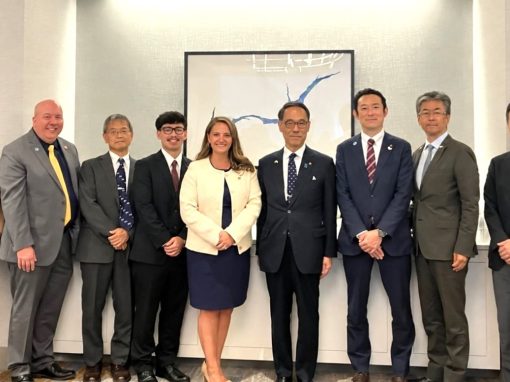
Mihalik; Kawamura; Iriti; Dr. Katherine Fell, former President of the University of Findlay; and Mayle pose for photo while on a delegation trip to Japan.

Delegations always took care to spend time with leaders in government, business and education while visiting Japan.
Musician, Coach, Friend. And the Guy who Made Everybody Laugh.
Before he came to Findlay, Iriti traveled with and performed in bands called the Molly McGuires and Rhode Apple. After moving to Findlay and during his time as county auditor he played in a whole band of Ohio county auditors – aptly named the Unfunded Mandates. Everywhere he went, he sang. He was known for picking up microphones and always brought those around him into the action – an especially great trait for karaoke in Japan. As part of delegations representing Findlay, Mayle, Mihalik, Kawamura, and Iriti – often joined by others – traveled to Japan together several times.

A promotional picture of Rhode Apple from their record label in 1973. Tony at center.
Tony was a coach. In the early 1980s he and friend Robert Starcher started a travel baseball team and coached their sons.
“He touched so many young men’s lives through his coaching and umpiring games,” Starcher said. “We had such a great time with the boys, traveling, meeting the parents. I learned a lot from him – he was an excellent coach and I’m sad to see him go, always so full of life, laughing and joking. You’ll get that from everyone who knew him.”
Iriti coached baseball for years, and when his son Mike was in high school, started coaching football with Findlay High School Head Coach Cliff Hite, “When I came to Findlay in 1996, he brought Ben Roethlisberger and Mike into the football office to meet the new head coach,” Hite said. “He coached them at a younger level, and they were freshman at the time. He said, ‘I think you’re going to want to see these two.’”
Mike Iriti and Roethlisberger were a dynamic duo for the history books their senior year.
“They were in sync more than most people are in sports,” Hite said. “It was like they knew each other’s thoughts, like they were twin brothers. They could anticipate the moves and actions of the other – it was a very efficient partnership.”

Coach Tony with son Mike.
Hite described Coach Tony as, “the most exuberant and positive guy, and he worked his tail off for us.” They were like brothers, arguing one minute and laughing hysterically the next. Tony would sing ‘Moondance’ in the football office and Hite would try to sing ‘Unforgettable.’
“I don’t think he was as impressed with my singing as I was of his.”
When they went to coaches’ clinics in Chicago, Hite would have a little fun with Iriti’s likeness to John Gotti, and would introduce him as the notorious mobster, “There were some who actually thought it was true! ‘Wow, you have John Gotti on your staff!?’”
And Tony is the one who, in 2005 when he was mayor, called Hite into his office and said, “‘Alright, you’re very into politics and you teach government and history. Have you ever thought about running for the House of Representatives?’ Tony knew I always wanted to do it.”
Hite resigned from football in 2006 and went on to serve in the Ohio House of Representatives from 2007 to 2011 and the Ohio Senate from 2011 to 2017. They continued to work together beyond football, for the benefit of Findlay.
“Tony was able to make everyone feel like they were the most important person in the room,” Hite said. “He made me feel like I was his favorite. We were like brothers. We had so much fun. It was love, a friendship that supersedes time, something that never goes away. His heart was bigger than his body – he gave you everything he had. We had a phrase in football, ‘all out all the time.’ That was Tony.”

Tony playing frontman at a class reunion.

Tony, daughter Tara, and granddaughter Lily with the late Findlay music legend Gavin Creel at The Cabaret. Creel and Tara Iriti were close friends, growing up in Findlay together.
Legacy
No matter how valiant the effort, the span of a feature article is not enough to document Tony Iriti’s legacy. After leaving Findlay in 2016 to pursue an economic development role in Henderson, Ky. and then in Mount Vernon, Ill., his remarkable impact continued. Iriti took exactly what he always did in Findlay to new communities. He brought people together, coached them to believe and dream, and made the community better. He was still working, still dreaming, still bringing people together right up until the end.
But really, there is no end.
In Downtown Findlay, Tony was celebrated at a special ceremony in Dorney Plaza on June 26. Community leaders, friends, and family spoke in fond remembrance and shared stories of his tremendous impact. As part of the ceremony, Mayor Christina Muryn read a proclamation issued by herself, the Hancock County Commissioners, and Hancock County Auditor Charity Rauschenberg “Celebrating the Life, Legacy, and Unmatched Enthusiasm of Anthony “Tony” Iriti.”
Christa Luttman, northwest regional liaison for the governor’s office spoke of her friend and read a proclamation from Gov. Mike DeWine and Lt. Gov. Jim Tressel recognizing Tony’s memorable legacy. Glass spoke of Columbus, Ind., the many trips, exciting results and fond memories. Following a Japanese custom, Kawamura fondly spoke of his friend, raised an imaginary glass and invited the crowd to join. Mayle spoke of his friend and mentor, outlining accomplishments and the way Iriti went about economic development in a revolutionary way. Pat Sadowski, attorney for Eastman Smith, FHCED long-time board member, and friend to Tony presented details on a foundation created to pay it forward in Tony’s memory. The foundation will serve to advance the art and accessibility of music by providing grants and scholarships that empower individuals, support education, and foster creativity in the Findlay-Hancock County community.
Mihalik, too, spoke in remembrance of Tony.
“…Tony didn’t just open doors, he opened minds. …One of the greatest gifts Tony gave this community was the confidence to believe that Findlay be more than just good, it could be exceptional – and that spirit continues to define Findlay today.”
Iriti’s kids – Mike, Nino and Tara – with many Iriti family members in tow, were presented a memorial plaque that is now installed in Dorney Plaza, near the Kwanzaan cherry trees representative of Findlay’s friendship with Japan. The family was grateful and overwhelmed by the outpouring of love.
Back in 2006, when Mayor Iriti penned his letter introducing the Greater Findlay Community Plan, he wanted the community to come together to define how we could move from “good to great.” In each of the margins, were inspiring quotes.
In the long run, we only hit what we aim at. – Henry David Thoreau
Be great in act, as you have been in thought. – William Shakespeare
I know the price of success: dedication, hard work, and an unremitting devotion to the things you want to see happen. – Frank Lloyd Wright
He closed his letter by taking us back to Jan. 20, 1886, when natural gas was struck at the Karg Well and Findlay was transformed. Findlay became the “City of Light.” The population quadrupled nearly overnight from 4,000 to 18,000. Thirty-one factories set up shop by 1887, and by 1889, Findlay had added 17 churches, 15 school buildings, three daily and six weekly newspapers, four streetcar lines, and about 1,600 buildings.
“One hundred and twenty years ago, our community was changed forever,” Iriti wrote. “…With your support, I am confident that the implementation of this Vision will be the “Karg Well” for our community over the next 120 years!”
He brought us into ‘his way’ – and our dream lives on.

Iriti’s kids, Nino, Tara and Mike react as former Findlay Mayor Lydia Mihalik presents to them a plaque memorializing their father during a celebration ceremony held in Downtown Findlay’s Dorney Plaza on June 26.

Community leaders who spoke at the ceremony pose with Mike, Nino and Tara, holding the plaque memorializing their father. The plaque has been placed near the Kwanzaan cherry trees representative of Findlay’s friendship with Japan, in Dorney Plaza.

Tony with his family, Mike, Nino, Tara, and their mother, Patti Garlock.

Tony’s legacy is in the greatness Findlay achieved together – and the dreams we chase for tomorrow.